

Sustainability · 2025
In this section50 topics
- Sustainability Policy4 items
- Sustainability Goals & UN SDGs4 items
- Policy Review3 items
- Business Value Chain1 item
- Stakeholder Analysis2 items
- Environmental Policy & Guidelines4 items
- Environmental Policy Review1 item
- Energy — Plan & Guidelines2 items
- Energy — Electricity Consumption1 item
- Energy — Fuel Consumption1 item
- Energy — Targets2 items
- Energy — Performance & Outcomes2 items
- Water — Plan & Guidelines2 items
- Water — Withdrawal, Discharge & Consumption1 item
- Water — Targets2 items
- Water — Performance & Outcomes2 items
- Waste — Plan & Guidelines4 items
- Waste — Generation, Disposal & Recycling1 item
- Waste — Targets2 items
- Waste — Performance & Outcomes2 items
- GHG — Plan & Guidelines4 items
- GHG — Emissions1 item
- GHG — Emissions Verification1 item
- GHG — Principles & Standards1 item
- GHG — Targets1 item
- GHG Targets — Net Zero1 item
- GHG — Performance & Outcomes2 items
- Environmental Legal Incidents1 item
- Other Environmental Management1 item
- Social Policy & Guidelines5 items
- Social Policy Review3 items
- Social — Principles & Standards Practised1 item
- Human Rights Due Diligence2 items
- Employees — Plan & Guidelines3 items
- Employees — Workforce2 items
- Employees — Remuneration & Provident Fund2 items
- Employees — Training & Development2 items
- Employees — Occupational Health & Safety2 items
- Employees — Labour Relations2 items
- Employees — Employee Representation2 items
- Employees — Targets2 items
- Employees — Performance & Outcomes1 item
- Customers — Plan & Guidelines3 items
- Customers — Satisfaction Results1 item
- Customers — Targets2 items
- Customers — Performance & Outcomes2 items
- Community & Social — Plan & Guidelines3 items
- Community & Social — Targets2 items
- Community & Social — Performance & Outcomes2 items
- Law Violation Incidents1 item
Sustainability Policy
Has a Sustainability Policy
Yes
Policy Description
ALT Telecom Public Company Limited and its group of companies (“ALT”) believe that conducting business with an emphasis on sustainability will ensure the company's stability and continuous long-term growth. The “Sustainability Policy” has been disclosed on the company's website. alt.co.th which will help create added value for stakeholders across the entire value chain in economic, community, and environmental dimensions, and support the organization in effectively achieving its vision and strategic goals in accordance with the good corporate governance principles established by the company.
All executives and employees of the company are responsible for supporting and driving the widespread implementation of the established policies throughout the organization. This includes disseminating policies to group companies and all stakeholder groups. Furthermore, it involves communicating and fostering engagement with various organizations to enhance sustainable development capabilities. Therefore, the company has established a management framework to serve as a guideline for international standards, with the following operational approaches and policies:
Economic and Governance Dimension
Good corporate governance and ethical business conduct, respecting rights and being responsible to stakeholders and shareholders, to generate and maintain good financial performance and ensure financial stability and sustainability for the company.
Committed to developing excellent products and services to meet and satisfy customer needs. Focusing on customer relationship management and developing quality growth strategies by emphasizing enhanced supply chain management efficiency and sound internal management to adapt to various changing circumstances.
Environmental Dimension
Sustainable management of natural resources and environment emphasizes the utilization of natural resources and environmental conservation throughout the business operation process, by employing appropriate technology to prevent environmental impacts that may arise from business activities.
Focusing on reducing social and environmental impacts from operations.
Promoting environmental awareness among employees and providing opportunities for employees to participate in managing and caring for
the environment, which helps create an atmosphere of participation and provides a channel for employees to collectively demonstrate their commitment and environmental consciousness.
Social Dimension
Operating with social responsibility through activities implemented with maximum efficiency and effectiveness, leading to harmonious coexistence in society, alongside creating added value (Value Creation) for the business together with all stakeholders for an improved quality of life.
Prioritizing employee welfare, developing employee potential, and strengthening human capital to support the company's various strategies.
Raising awareness among stakeholders regarding the sustainability management policy and operational guidelines to collectively promote further sustainable development.
Developing employee potential and focusing on occupational safety and health in the workplace.
Adhering to the principles of human rights, equality, fairness, and non-discrimination.
In 2025, the company reviewed its sustainability policy to align with its goals and operational plans, and established guidelines. practices Aspects Sustainability of the company and its group of businesses.
Policy Document Link
https://alt.co.th/wp-content/uploads/2025/03/ESG-Policy-%E0%B8%99%E0%B9%82%E0%B8%A2%E0%B8%9A%E0%B8%B2%E0%B8%A2%E0%B8%94%E0%B9%89%E0%B8%B2%E0%B8%99%E0%B8%84%E0%B8%A7%E0%B8%B2%E0%B8%A1%E0%B8%A2%E0%B8%B1%E0%B9%88%E0%B8%87%E0%B8%A2%E0%B8%B7%E0%B8%99-Rev.2_25-02-25_EN.pdf
Page Number in Report
9
Sustainability Goals & UN SDGs
Introduction
The company has set sustainability goals, divided into three phases, to ensure continuous business sustainability amidst the rapid uncertainties and changes occurring globally across various dimensions.
• Short-term goals (2023-2024): Analyze data and build stability.
Practices
Preliminary analysis: Detailed collection of greenhouse gas emission data from electricity and energy consumption in Scopes 1, 2, and 3 from various Site Facilities.
Participation in projects and standards: Becoming part of the SET Carbon Sandbox project to test and improve emission reduction approaches. greenhouse gases within the organization.
Setting interim targets: Establishing sub-targets, such as reducing emissions by 5-10% by 2025, as a stepping stone towards long-term goals.
Training and knowledge enhancement: Participating in the Stock Exchange of Thailand's "ESG DNA for Corporate Employees" project.
• Mid-term goals (2025-2035): Reduce greenhouse gas emissions by 20% by 2035, covering Scope 1, 2, and 3 emissions.
Part 1 Business Operations and Performance
Practices
Renewable energy utilization: Investing in renewable energy sources such as solar and wind power at Site Facilities, with the goal of covering 50% of total energy consumption within the organization.
Factor every quarter.
Collaboration with partners, customers, government agencies, and private sectors: Encouraging partners and customers to reduce greenhouse gas emissions through the selection of materials and equipment. with low carbon
• Long-term goals (2036-2040): The company is committed to achieving net-zero greenhouse gas emissions by 2040.
Approach Practice
Full-scale renewable energy utilization : Expanding 100% renewable energy use across all Site Facilities, including the adoption of clean technologies such as Energy Storage systems to support energy consumption during various periods.
Carbon Offset : Implement carbon offsetting measures, such as purchasing Carbon Credits or investing in reforestation projects, to offset remaining emissions in the system.
Sustainability Issue Assessment
to reflect factors influencing the organization's business operations in environmental, social, economic, and governance aspects, as well as issues that may impact the organization's value creation throughout the business value chain, including the needs and expectations of stakeholders. Materiality assessments are conducted annually to review changes in issues affecting the organization and stakeholders, in order to establish effective and balanced management approaches. The sustainability materiality assessment involves 3 steps as follows:
1. Identification of key issues for the organization and stakeholders. Sustainability issues are selected in collaboration with various departments, considering relevant international standards, requirements, and practices, as well as alignment with the organization's context, risks, strategies, and sustainability management. The needs and expectations of stakeholders are also taken into account. The company defines the scope of sustainability issues based on the impact of its operations throughout the value chain, covering both internal and external aspects.
2. Assessment of materiality, considering opportunities and impacts on the company's value creation, covering financial aspects, business processes, impacts on customers, partners, and employees, as well as the level of interest, impact, and importance for creating value for stakeholders.
These key issues are then integrated into the strategic planning and management process for effective implementation.
3. Verification and Certification of Assessment Results. The company has appointed a Nomination, Remuneration, and Corporate Governance Committee, which is responsible for setting goals, strategies, and operational plans. The Nomination, Remuneration, and Corporate Governance Committee oversees
Sustainability Management: Monitoring operational progress, considering, reviewing, and approving the results of key issue assessments.
organizational sustainability.
Results of the Sustainability Materiality Assessment
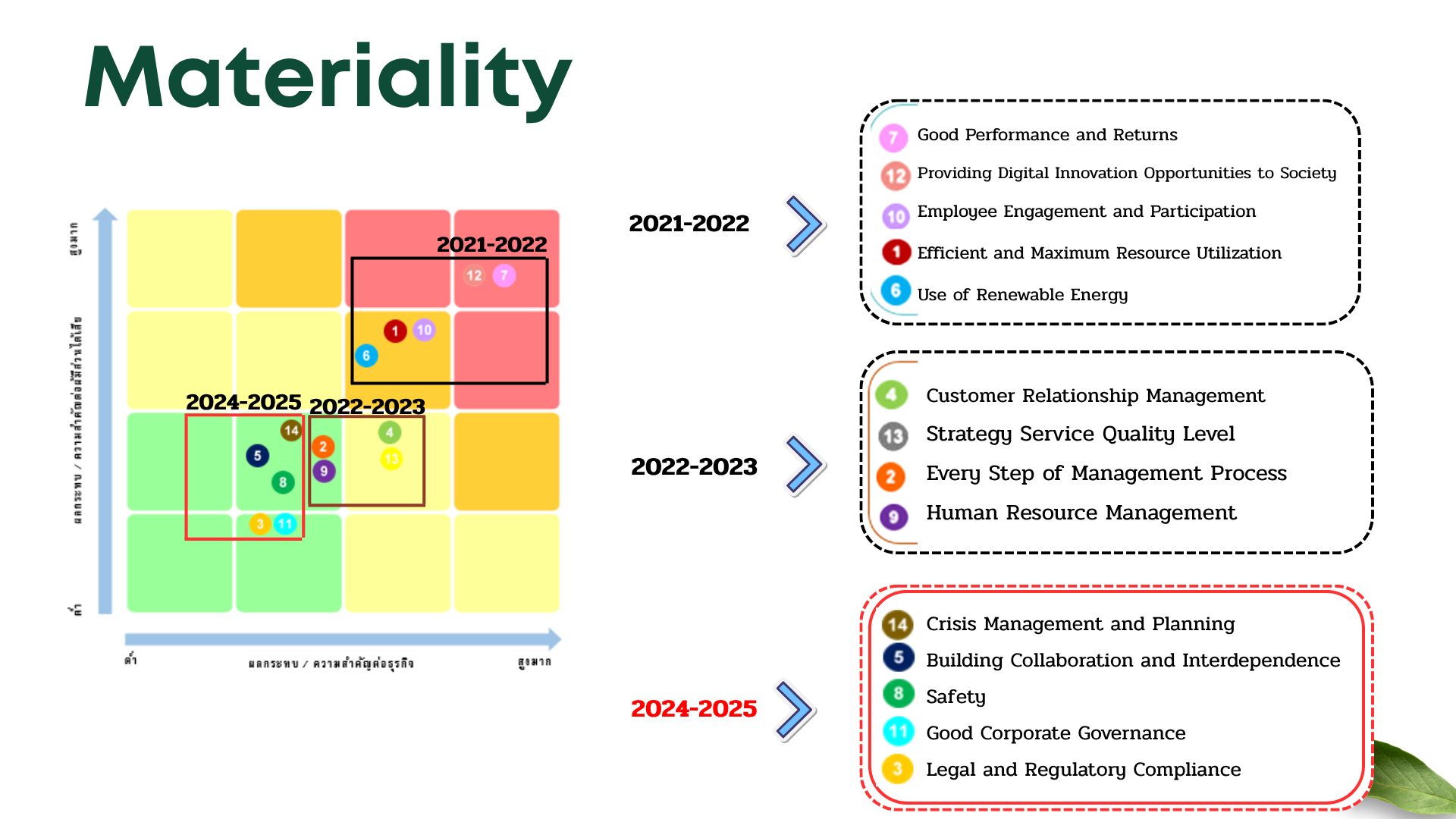
In 2025, the company implemented its sustainability management plan as targeted, and the Nomination, Remuneration, and maximum benefit, promoting renewable energy use, and reducing greenhouse gas emissions, responding to economic and social development with digital innovation, creating good relationships with customers, improving internal control systems to reduce redundancy, strengthening employee engagement, and raising awareness of business ethics. of the business, referencing key issues identified in 2020-2021 and considering trends.
Significant macroeconomic changes, opinions from stakeholders key stakeholders, along with considering potential risks and opportunities that may
occur throughout the value chain. Sustainable Development Issues (Materiality) All 8 are considered issues with moderate to high economic, environmental, and social impacts, affecting assessment, decision-making, or confidence from high-level stakeholders, and will be issues considered in the company's business plans in both the short and long term. Materiality also linked to and covering economic, environmental, and social sustainability issues that the company prioritizes and has continuously addressed. due to, under the corporate governance policy. good, such as innovation and technology development, product and service responsibility, renewable energy use, and. Employee Care and Development Community and social development alongside the company's business operations.
The company aims to conduct business under the principles of good governance, transparency, accountability, and consideration for the interests of all stakeholders.
1. Good Corporate Governance
The Board of Directors oversees operations to comply with laws, regulations, and organizational policies, and establishes a clear governance structure with appropriate segregation of duties and responsibilities.
2. Transparency and Information Disclosure
The company discloses important information accurately, completely, and in a timely manner to enable investors and stakeholders to make informed decisions.
3. Anti-Corruption and Bribery
The company clearly defines its anti-corruption and bribery policy, covering directors, executives, employees, and partners, and provides channels for complaints and independent investigation processes.
4. Enterprise Risk Management (ERM)
The company has established a systematic enterprise risk management process, covering strategic, financial, operational, legal, technological, and sustainability risks, and regularly reports to the Board of Directors.
5. Internal Control
The company has established appropriate and adequate internal control systems to prevent errors, fraud, and potential damages, and continuously evaluates the effectiveness of these internal control systems.
6. Business Ethics
The company establishes a code of business conduct as a guideline for directors, executives, and employees to foster an organizational culture committed to honesty, integrity, and responsibility.
7. Data Security (PDPA / Cyber / Data Privacy)
The company prioritizes personal data protection and cybersecurity by establishing measures for data access control, cyber threat prevention, and compliance with relevant personal data protection laws.
The Company's IT Security Policy
The company prioritizes the management of Information Technology (IT) security, which is crucial for supporting continuous, transparent, and efficient business operations. The company has established cybersecurity policies and practices to prevent risks from cyber threats, unauthorized data access, and the leakage of critical information.
The company oversees IT Security under a Good Corporate Governance (CGR) framework, assigning management and the Information Technology (IT) department responsibility for establishing control measures, supervision, and monitoring operations to strictly adhere to defined policies.
Key Practices
1. The company has established measures for controlling access to information systems (Access Control) by using authentication systems, role-based access rights, and data encryption to prevent unauthorized access.
2. Cybersecurity threat prevention systems, such as Firewalls, Antivirus, and intrusion detection systems, are installed and managed to enable timely response to threats.
3. The company stores and manages data, especially personal data, in compliance with relevant laws, and has measures in place to prevent data leakage.
4. A data backup system and a Disaster Recovery Plan (DRP) are in place, including regular testing of the plan, to ensure business continuity.
5. IT risks are regularly monitored, reviewed, and assessed, and security measures are updated to align with evolving threat landscapes.
6. The company promotes cybersecurity awareness among employees through communication, training, and knowledge sharing to prevent risks from information system usage.
7. Measures are in place for the appropriate destruction of data and decommissioned equipment to prevent unauthorized use of information. Governance and Information Disclosure The company regularly reports on information security performance, significant risks, and cybersecurity incidents to management and relevant committees, and discloses material information in its annual report (Form 56-1 One Report) to ensure transparency for stakeholders.
Business strategies to achieve sustainability goals.
Setting Sustainability Goals (ESG) Aligned with Long-Term Business Objectives
The company sets its sustainability goals (Environmental, Social, and Governance: ESG) in alignment with its long-term vision and growth strategy, focusing on becoming a secure, safe, and environmentally friendly provider of telecommunications and digital technology infrastructure.
Environmental Dimension
The company aims to reduce its environmental impact from business operations by continuously setting goals for energy management and greenhouse gas emission reduction. The company has established a long-term goal of achieving Net Zero Emissions by 2040 to support the transition to a Low Carbon Economy.
Key operational guidelines include:
Continuous development and management of the organizational Carbon Footprint.
Enhancing energy efficiency in networks and equipment stations.
Supporting the use of alternative energy, such as solar power in telecommunications infrastructure.
Development and implementation of technologies that reduce greenhouse gas emissions in operations.
The company continuously monitors and evaluates its operational performance to achieve the set goals.
Social Dimension
The company aims to create value for society and stakeholders by leveraging its technological capabilities and digital infrastructure to enhance the quality of life for the public, such as:
Development of Smart City projects and intelligent security systems (AI / CCTV).
Expanding telecommunication networks to increase access to digital services.
Implementing projects that promote community safety alongside personal data protection.
while also promoting community and stakeholder engagement at every stage of operations.
Governance Dimension
The company conducts its business under the principles of good corporate governance, committed to transparency, accountability, and effective risk management, with key approaches including:
Responsible Governance of Technology and Data (Data Governance)
Personal data protection in accordance with relevant laws.
Promoting business ethics and anti-corruption at all levels of the organization.
Alignment with the organization's long-term goals.
The company's ESG goals are integrated into its organizational strategic plan to support Sustainable Growth, focusing on revenue generation alongside reducing environmental impact, creating shared value with society, and maintaining good corporate governance standards. particularly the Net Zero target by 2040, which is one of the organization's key strategic goals for enhancing competitiveness and meeting long-term stakeholder expectations.
The company believes that operating within the ESG framework will enhance competitiveness, increase stakeholder confidence, and support the organization's long-term sustainable growth.
Disclosure of Performance Indicators related to the Company's Sustainable Business Operations (ESG)
The company has established quantitative environmental indicators to support its sustainable business goals, focusing on reducing greenhouse gas emissions through renewable energy projects under Thailand's Voluntary Emission Reduction Program (T-VER).
Currently, the company has completed the installation of solar energy systems in various projects and is in the process of gradually registering projects under T-VER, with 6–7 projects (sites) already submitted for registration.
The company anticipates that these projects will collectively reduce greenhouse gas emissions by approximately 10,000 tons of carbon dioxide equivalent ( tCO2e ) within 7 years, or an average of approximately 1,429 tCO2e per year.
Furthermore, the company plans to gradually register an additional 17–18 remaining projects under T-VER by 2027 to continuously enhance its potential for greenhouse gas emission reduction and support the organization's environmental goals.
The company regularly monitors and evaluates its operational performance and will transparently disclose progress and performance data to stakeholders to ensure the effective achievement of greenhouse gas emission reduction targets and the Net Zero goal by 2040.
Tax Policy, Regulations, Practices, or Planning
Commitment to Tax Law Compliance and Tax Governance
The company prioritizes tax operations under the principles of good governance (Tax Governance), adhering strictly, transparently, and verifiably to relevant tax laws, regulations, and practices in all countries where it operates.
The Board of Directors and senior management play a role in overseeing (Board Oversight) tax management to ensure it is appropriate, aligned with organizational strategy, and the Risk Management Framework. The company has established adequate internal control systems and audit processes to ensure that tax calculations, recording, and submission are accurate, complete, and timely.
The company conducts tax planning within the framework of laws and good governance principles, utilizing tax benefits as prescribed by law appropriately, transparently, and in alignment with the law's objectives. Such benefits will only be applied when all qualifications are met and related conditions are strictly adhered to, considering business reasonableness and actual operations (Substance over Form).
The company has no policy to engage in any inappropriate tax avoidance (Aggressive Tax Avoidance) or to use tax structures that are inconsistent with the spirit of the law. It adheres to the principle of paying taxes in the country where income is generated and reflecting actual economic activities.
Furthermore, the company regularly monitors changes in tax laws, develops the knowledge and capabilities of relevant personnel, and in cases of complex tax issues, will consider seeking advice from external experts or relevant agencies to ensure operations comply with legal principles and best practices, as well as disclosing tax information adequately, appropriately, and in line with stakeholder expectations.
Has Sustainability Goals
Yes
Goals Description
Sustainability Management in the Economic and Corporate Governance Dimensions
The company places importance on sustainability management in the economic and governance dimensions, which are crucial approaches for stable organizational growth alongside responsibility towards stakeholders. In the economic dimension, the company focuses on sustainable business growth through innovation development, economic risk management, and community engagement to create long-term economic value.
The company has therefore established sustainability management strategies to ensure continuous business sustainability amidst the rapidly evolving uncertainties and changes in various global dimensions, including:
1. Aim to generate good performance and returns. The rapidly changing technological landscape has resulted in
continuously impacting the business, requiring the company to adapt to changes. The company continues to pursue its business plan and established goals, focusing on smart energy businesses, smart cities, and improving consumer well-being through various e-platforms. These services will help drive the businesses of both public and private sector clients, enhancing agility, elevating service delivery with digital systems, reducing costs, and emphasizing environmental preservation and improving the quality of life for the public, all within a framework of good corporate governance.
2. Optimize resource utilization for maximum benefit. The company is proceeding with the utilization of the fiber optic communication network available nationwide within the group of companies to promote shared usage among operators and connect domestic networks with international submarine networks, thereby enabling Thailand to become the ASEAN Digital Hub.
3. Promote the use of renewable energy and reduce greenhouse gas emissions. The company aims to develop renewable energy businesses and has guidelines to encourage industrial factory operators, households, public sector, and private sector to switch to alternative energy (Renewable Energy), reducing the use of electricity that causes pollution and transitioning to clean energy to reduce greenhouse gas emissions contributing to global warming.
4. Respond to economic and social development with digital innovation. This involves integrating innovation and smart technologies with communication systems, as well as developing platforms to serve as supplementary services for various devices related to smart city systems, smart energy systems, and the insurance business, leading to the development of cities into smart cities to enhance the quality of life for communities and society.
5. Enhance employee engagement and raise awareness of the company's business ethics. Personnel are valuable resources of the organization. All successes stem from the knowledge, abilities, and dedication of its personnel. Therefore, personnel development, coupled with fostering organizational engagement and raising awareness of business ethics, is a crucial factor for achieving established goals. The company thus has strategies to achieve these goals by maintaining a healthy work-life balance, aiming to boost employee morale, including caring for physical, mental, and financial health, and continuously developing potential to enhance employee capabilities.
6. Focus on building relationships with existing and new customer groups. The company considers the needs and expectations of both existing and new customer groups, providing care throughout project proposals, professional installation services, and after-sales service to ensure continuous customer satisfaction.
7. Modernize internal control systems and reduce redundancy. Technology is changing rapidly, requiring organizations to modernize their processes and internal control systems and reduce redundancy to achieve agility, maximum effectiveness, and efficiency.
UN Sustainable Development Goals
| SDG Goal |
|---|
| Goal 3 Good Health and Well-being |
| Goal 3 Good Health and Well-being |
| Goal 7 Affordable and Clean Energy |
| Goal 7 Affordable and Clean Energy |
| Goal 8 Decent Work and Economic Growth |
| Goal 8 Decent Work and Economic Growth |
| Goal 9 Industry, Innovation and Infrastructure |
| Goal 9 Industry, Innovation and Infrastructure |
| Goal 11 Sustainable Cities and Communities |
| Goal 11 Sustainable Cities and Communities |
Policy Review
Policy Reviewed This Year
Yes
Policy Changed This Year
Yes
Review Details
In 2025, the Company reviewed and revised its sustainability policy, which was considered and approved by the resolution of the Board of Directors Meeting No. 2/2025, by making further amendments to its goals and practices to serve as a guideline for moving towards a low-carbon society.
Business Value Chain
Value Chain Description
The company considers the value chain from upstream to downstream, which is crucial for its business, starting from raw material intake to production and installation, to transform them into products or services that yield maximum benefits economically, socially, and environmentally. It is committed to creating added value for stakeholders in the value chain, including fostering holistic value and mutual benefits. The impacts and expectations of stakeholders are considered through interviews, discussions, questionnaires, participation in various seminars, etc., to serve as data for impact assessment. The company aims to create connections among stakeholders in the value chain, such as partners and employees, to deliver products and services to customers, leading to good returns for shareholders and co-investors.
Sustainable Supply Chain Management
(Sustainable Supply Chain Management)
The company recognizes that responsible supply chain management is a crucial factor for competitiveness, the continuity of telecommunications infrastructure services, and the creation of sustainable value for all stakeholders. Therefore, the company focuses on systematically integrating Environmental, Social, and Governance (ESG) principles into its procurement processes and partner management.
1. Strategic Partner Governance and Management Structure
The company has established a supply chain management structure under the responsibility of the Procurement Department, with executive-level oversight to ensure operations align with company policies and sustainability goals.
The company classifies partners based on their level of importance and impact on the business, namely:
Critical Tier 1 Vendors such as providers of telecommunications network construction, fiber optic systems, infrastructure equipment, and network support systems.
Non-Critical / Supporting Vendors
This classification enables the company to determine appropriate levels of control, risk assessment, and performance monitoring tailored to the characteristics and risks of each partner group.
2. ESG Risk Management in the Supply Chain
The company systematically assesses partner risks, covering key ESG issues relevant to the telecommunications infrastructure business, including:
Environmental Aspect such as construction waste management, energy consumption, use of environmentally friendly materials, and greenhouse gas emissions.
Social Aspect such as human rights, employment conditions, and occupational safety and health for workers.
Governance Aspect such as anti-corruption, not giving or receiving bribes, and transparency in business operations.
The results of risk assessments are used in partner selection, contract term definition, and the development of joint improvement plans with partners, especially for those with high-level risks.
3. Responsible Procurement Policy
The company stipulates Responsible Procurement Policy by integrating ESG principles as part of the procurement process from upstream to downstream, to ensure that partners conduct business in accordance with the same standards as the company.
The company requires all partners to adhere to and comply with Supplier Code of Conduct which covers human rights, labor protection, safety, environmental preservation, and anti-corruption issues.
4. Partner Selection and Registration Process
The company applies criteria for quality, technical capability, price, and Environmental and Social Criteria to be used in the consideration of partner selection by
New Approved Vendor must pass an ESG qualification assessment before registration.
Current Approved Vendor will have their performance in quality, safety, and ESG regularly reviewed.
In cases where non-compliance issues are found, the company will establish an improvement plan with the partner and closely monitor its progress.
5. Partner Monitoring, Verification, and Capability Development
The company continuously monitors and evaluates partner performance through various processes, such as:
Supplier Self-Assessment
Internal or Third-party Audit
Site Visit to partner's operational premises, especially for critical partners and high-risk partners.
In addition, the company also emphasizes Supplier Development by supporting the exchange of knowledge on safety standards, environmental practices, and ESG guidelines to enhance the efficiency and long-term sustainability of the supply chain.
6. Business Continuity and Network Security
As the company's business involves critical infrastructure, it prioritizes managing business continuity risks of its partners to ensure that construction, maintenance, and network service operations can proceed continuously and stably.
7. Information Disclosure and Transparency
The company discloses information on supply chain management, policies, and ESG performance through Annual Information Statement (56-1 One Report) and the company's communication channels to reflect transparency, accountability, and commitment to sustainable business operations.
Procurement process, and the company's procurement adheres to environmentally conscious guidelines.
The company's improved procurement process focuses on good governance, transparency, and sustainability by establishing clear approval procedures, utilizing electronic systems to mitigate corruption risks, and systematically archiving documents for traceability. The list of selected suppliers is transparently disclosed in the Approved Supplier List (ASL). Furthermore, the company has elevated its operations to align with environmental and sustainability standards, having received ISO 14001 certification (Environmental Management System), Green Industry certification from government agencies, and participating in the Stock Exchange of Thailand's greenhouse gas management project (SET Carbon) to support greenhouse gas emission reduction and sustainable business operations.
The company conducts procurement in accordance with Green Procurement guidelines, prioritizing the selection of products and services that minimize environmental impact. Selected suppliers must meet environmental standards, such as ISO 14001 (Environmental Management System) or related standards, to confirm the presence of a clear and verifiable environmental management system. Furthermore, the company supports procurement from suppliers who can report or demonstrate the carbon footprint of their products and services to help monitor and reduce greenhouse gas emissions in the supply chain.
In terms of operational enhancement, the company has developed guidelines aligned with ESG principles, Carbon Footprint, and CGR. It has established selection and evaluation criteria for suppliers that encompass both environmental and social dimensions, such as efficient energy use, proper waste management, support for Green Products, and adherence to relevant standards like ISO 14001 and ISO 14064.
In the social dimension, suppliers must have fair labor policies, ensure workplace safety, and not violate human rights. They should also support local employment and community engagement to create a responsible supply chain.
Finally, the company has a continuous system for evaluating and monitoring supplier performance, utilizing ESG and sustainability indicators. It transparently reports procurement results reflecting CGR and ESG Performance, and discloses information in the 56-1 (One Report), covering procurement policies, green product usage, carbon footprint reduction, and partner participation in a sustainable supply chain.
Policies or practices related to promoting partner potential and capabilities.
The company has a Supplier Code of Conduct that emphasizes building collaboration with partners, aiming for sustainable joint business operations. It continuously supports and develops partner capabilities through knowledge sharing, performance evaluation, and recommendations for improvement, to elevate operational standards and strengthen the entire supply chain.
Plans to develop and enhance partner capabilities.
The company plans to develop and enhance the capabilities of its partners by sourcing online courses related to business, such as quality, supply chain management, and ESG. It also encourages and promotes partners to participate in these training programs. Key performance indicators include the number of courses partners attend and tracking learning outcomes, such as course completion rates, to continuously improve partner efficiency.
Performance from promoting the potential and capability for sustainable business operations with partners.
In 2025, the company organized online training courses on CARBON FOOTPRINT assessment guidelines to enhance ESG capabilities. The company successfully achieved 100% of its set goals, with all employees and partners participating in the training as planned. This significantly elevated knowledge and understanding of greenhouse gas management, and the acquired knowledge has begun to be applied in data collection, carbon footprint assessment, and the establishment of guidelines for reducing greenhouse gas emissions in operational processes.
These operational results reflect the effectiveness of developing partner and personnel capabilities, leading to a tangible elevation of ESG standards for the organization and its supply chain, and supporting long-term sustainable growth.
Stakeholder Analysis
Introduction
The Company has considered stakeholders within its value chain and identified several groups of stakeholders affected by its business operations under the Company's management. These stakeholders are considered crucial components in driving the Company's business. The Company has categorized stakeholders into 8 groups: shareholders and investors, customers, employees, business partners, joint venture companies, landowners, communities and society, and government agencies and regulators. The Company prioritizes three groups of stakeholders: shareholders and investors, customers, and employees, with whom the Company continuously communicates and organizes activities to foster engagement. However, the approach to engaging each stakeholder group varies according to their role within the Company and their specific characteristics. The resulting outcomes will effectively create added value for both the Company and its stakeholders. The key expectations of stakeholders for 2025 are as follows:
Stakeholder Analysis
| Stakeholder Type | Stakeholders | Stakeholder Expectations | Response to Expectations | Communication Activities |
|---|---|---|---|---|
| External stakeholders | 2904 · Description: Investors or investment institutions · 2913 · Description: Shareholders | 1. Communicate and ensure understanding among investors regarding the company's performance and strategic direction. 2. Good Corporate Governance. 3. Transparent and Timely Disclosure of Information. 4. Building Business Sustainability according to ESG. 5. Moving Towards Sustainable Stocks. | 1. Adjust strategic plans to align with economic conditions 2. Ensure good corporate governance 3. Join as a member of the Private Sector Collective Action Coalition Against Corruption (CAC) 4. Announce commitment to a low-carbon society 5. Aim to build business sustainability by considering ESG principles: Environmental, Social, and Governance | 2941 · Description: Online Communication · 2944 · Description: Annual General Meeting (AGM) · 2949 · Other name: Opportunity Day or Analyst Meeting, Company Visit Activities, Interviews with Shareholder Representatives, Investors · Description: Others |
| External stakeholders | 2921 · Description: Employees | 1. Employees possess skills, knowledge, and potential to support future growth. 2. Good welfare benefits for personnel. 3. A good and safe working environment. 4. Accurate understanding of operational performance and organizational status. 5. Work-life balance. | Conducting organization-wide mapping to prepare appropriate personnel development programs that align with needs and are responsive to changes. 3. Establishing channels for personnel to submit complaints via email to the Fact-Finding Committee. 4. Arranging quarterly communication meetings between senior management and employees at all levels throughout the organization regarding the company's status and performance. | 2941 · Description: Online Communication · 2942 · Description: Internal Meeting · 2946 · Description: Employee Engagement Survey · 2947 · Description: Satisfaction Survey · 2949 · Other name: 180-degree Performance Appraisal, Employees receive continuous development of skills and knowledge · Description: Others |
| External stakeholders | 2923 · Description: Customers | 1. Receive quality products and services that meet customer needs 2. Fair pricing 3. Timely delivery of products and services 4. Good after-sales service 5. Convenient and fast communication channels 6. Building business sustainability according to ESG principles | 1. Inspect the quality of products and services before delivery to customers. 2. Establish after-sales service channels through a Service Desk system and online platforms. 3. Regularly conduct customer satisfaction surveys. 4. Announce commitment to a low-carbon society. 5. Aim to build business sustainability by considering ESG principles: Environmental, Social, and Governance. | 2941 · Description: Online Communication · 2947 · Description: Satisfaction Survey · 2949 · Other name: Visit customer, Exhibition, Prototype, Relationship Management · Description: Others |
| External stakeholders | 2899 · Description: Suppliers | 1. Pay wages and compensation on time 2. Conduct joint meetings, both formal and informal 3. Fair and transparent procurement 4. Clear scope and terms of work 5. Fair practice in accordance with good governance principles and business ethics | 1. Comply with contracts, agreements, or various conditions with business partners. In cases where compliance is not possible, partners must be notified in advance to jointly find solutions and prevent damage. 2. Communication of guidelines and practices regarding good governance and business ethics to business partners. 3. Treat business partners equally and fairly, based on fair returns for both parties. Do not discriminate against business partners, without bias, and foster fair competition among business partners. | 2938 · Description: Visit · 2941 · Description: Online Communication · 2943 · Description: External Meeting · 2949 · Other name: Supplier / Sub-contractor Quality Assessment · Description: Others |
| External stakeholders | 2932 · Description: Joint venture partners | 1. Business development and mutual growth 2. Conducting business with transparency 3. Fair practices in accordance with good governance and business ethics 4. Appropriate returns as mutually agreed upon 5. Sharing resources for maximum efficiency and cost savings | 1. Seek co-investors with strategic business alignment to create synergy and add value to both parties' businesses. 2. Join as a member of the Thai Private Sector Collective Action Against Corruption (CAC). 3. Promote shared usage among operators and connect domestic networks with international submarine networks. | 2938 · Description: Visit · 2941 · Description: Online Communication · 2943 · Description: External Meeting · 2949 · Other name: Relationship Management · Description: Others |
| External stakeholders | 2909 · Description: Lessors | 1. Valuable, appropriate, and timely returns 2. Application of technology to develop the area 3. Fair lease agreements 4. Full compliance with rules and laws | 1. Comply with contracts, agreements, or various terms and conditions with property owners. 2. Manage contracts to ensure fairness and transparency. | 2941 · Description: Online Communication · 2949 · Other name: Present the project and returns · Description: Others |
| External stakeholders | 2902 · Description: Community · 2928 · Description: Society | 1. Prioritize community and environmental friendliness. 2. Prioritize safety of life and property. 3. Promote activities beneficial to the community. 4. Prioritize quality of life. 5. Have a guideline for creating value in the community economy. | 1. Promote understanding of frequency band safety issues. 2. Encourage the use of clean renewable energy, such as electricity generation from solar power. 3. Collaborate in creating digital innovations to enhance life safety. | 2940 · Description: Social Event · 2945 · Description: Complaint Reception · 2949 · Other name: CSR activities, communication, and providing knowledge in telecommunications · Description: Others |
| External stakeholders | 2931 · Description: Government agencies and Regulators | 1. Strictly adhere to laws and regulations 2. Conduct business transparently and fairly 3. Ensure transparent disclosure of information 4. Cooperate with various activities 5. Combat business corruption 6. Achieve business sustainability according to ESG principles | 1. Strictly adhere to laws, regulations, and government agencies. 2. Participate in public hearings of government and regulatory agencies. 3. Become a member of the Private Sector Collective Action Coalition Against Corruption (CAC). 4. Declare commitment to a low-carbon society. 5. Aim to build business sustainability by considering ESG principles: Environmental, Social, and Governance. | 2941 · Description: Online Communication · 2948 · Description: Training / Seminar · 2949 · Other name: Present projects and apply for various permits, engage in listening and exchanging opinions, and cultivate awareness in collaboration with the IOD Institute. · Description: Others |
Environmental Policy & Guidelines
Introduction
ALT Telecom Public Company Limited and its group companies, hereinafter referred to as "the Company," are committed to conducting business sustainably based on environmental responsibility. The Company recognizes and prioritizes preventing and reducing environmental impacts arising from business operations in all processes, from production, installation, and service provision, to innovation development, to continuously mitigate potential impacts. Furthermore, targets for valuable natural resource utilization have been set, along with plans and measures to address environmental issues.
<5GAH39nJeK6I>
The company prioritizes driving the organization through innovation in accordance with its "Policy on Promoting Creativity and Innovation Management." It aims to develop technologies and products that can rapidly respond to the evolving needs of customers and stakeholders, while simultaneously enhancing competitive capabilities and fostering sustainable organizational growth.
From the meter development projects in the past period, the company has evaluated actual usage results and identified opportunities to enhance product efficiency. Consequently, it developed "Smart Meter Energy Max," an innovation that combines the strengths of existing technology with improvements addressing real-world usage limitations, while also adding a prepaid function to increase flexibility and efficiency in energy management for electricity users.
The product is designed to support all long-range communication technologies, with the communication module separated from the measurement unit but still within the same structure. This allows for hot-swappable module replacement (replaceable while powered), enhancing service continuity, reducing maintenance time, and improving system management efficiency.
Furthermore, the smart meter supports all types of electricity users, covering both direct connection and transformer-based (CT and CT/VT) installation methods. It also connects to a Meter Management System (Head-End System) and an online prepaid system, enabling transparent, verifiable, and efficient control, monitoring, and management of energy consumption.
This innovation development reflects the company's commitment to utilizing technology to support operations in accordance with Good Corporate Governance principles, considering transparency, accountability, and value creation for all stakeholders, as well as supporting long-term sustainable growth.
Processes or plans that promote innovation or development.
Following the company's receipt of the Smart Grid development project contract in Pattaya City, Chonburi Province, covering AMI, MWM, and IT Integration systems in 2019, along with the project to procure electronic meters to replace rotating disc meters according to the 2021 plan. Both projects utilize meters of different models and technologies, resulting in incompatibility and affecting electricity usage for service providers and users.
The company has therefore undertaken innovation and technology development in line with Good Corporate Governance (CGR) principles and the 56-1 One Report disclosure guidelines, covering the following processes:
1. Innovation Development Approach
Due to the previous limitation where meters were designed to support only one technology with an internal communication module, resulting in inflexibility of use, the company focused on developing new smart meter models capable of supporting various communication technologies (Multi-Communication Technology) and adding a prepaid function.
2. Improvement & Enhancement
The smart meter is designed to support various hybrid long-range communication technologies such as RF/PLC, Cellular, and allows for external hot-swappable modular design (replaceable while powered) to reduce the need for temporary power distribution system shutdowns during communication module replacement or maintenance. This enhances service continuity and minimizes impact on electricity users, while also incorporating BLE wireless communication for short-range meter communication.
3. Technology Trend Monitoring
The company continuously monitors Smart Meter technology to support Smart Grid projects, such as developing connectivity with the operating system (AMI HES) or integrating the operating system (AMI HES) with existing utility systems to enable faster analysis and problem-solving using data from service points.
4. Testing & Pilot Implementation Process
Smart Meter Energy Max has undergone testing by external laboratories in accordance with TIS and IEC standards, and has received dSure 2-star certification for safety and functionality. It is currently undergoing field testing and pilot projects to evaluate communication efficiency, system stability, and compatibility with existing infrastructure.
5. Outcomes
The results of this innovation development have reduced previous technological limitations, increased operational flexibility, shortened installation and maintenance times, and reduced the need for power outages. This has led to improved service quality and increased satisfaction among electricity users.
6. Monitoring & Governance
The company has established regular monitoring and performance tracking processes, including assessing technology risks, data security, and compliance with relevant standards, to adhere to good governance principles.
7. Scaling & Continuous Improvement
The company plans to extend this innovation to other projects, including developing additional functions such as a Prepaid System, Energy Analytics, and integration with future energy management systems to support sustainable growth.
Details of business and social innovation or development within the company.
From the development of meters for the two aforementioned projects, the company believes that new meters should be developed to address real-world usage problems and add a prepaid function.
Smart Meter Energy Max was developed by combining existing strengths and addressing real-world usage problems while adding a prepaid function. It supports all long-range communication technologies by installing communication modules externally to the measurement unit but within the same structure, allowing for hot-swappable module replacement (replaceable while powered). It is developed to support all types of electricity users with the following meter usage requirements: 1-phase 2-wire direct connection, 3-phase 4-wire direct connection, 3-phase 4-wire current transformer (CT) connection, and current and voltage transformer (CT, VT) connection, coupled with the development of an online prepaid system connected to the meter operating system.
(Head-End-System)
Outcomes from the company's business and social innovation development.
Smart Meter Energy Max is designed to support various long-range communication technologies by allowing external connection of communication modules for immediate use, such as Cellular Module, Hybrid Communication Module, and RF Module. It also features a prepaid function, an online prepaid system, and a Meter Operating System (Head-End-System), resulting in:
1. Expanded customer base into the private market.
2. Continuous system communication allows users to plan their electricity consumption.
3. Customers are not affected by temporary power outages, preventing disruption to ongoing work.
4. Continuous monitoring of electricity flow prevents dangerous load activation when unattended or electricity leakage.
Product Development with Environmental Considerations
The company recognizes the importance of reducing environmental impacts from business operations in all processes, including innovation and product development. Therefore, it aims to promote the design and development of products with consideration for efficient resource utilization and reduced environmental impact throughout their lifecycle, with the following guidelines:
-
Promote the design and development of products and solutions that reduce energy and resource consumption during use, to achieve maximum efficiency and minimize environmental impact.
-
Support the selection of appropriate and environmentally friendly materials, equipment, or technologies, considering cost-effectiveness and long-term impacts.
-
Focus on developing durable products that can be used for a long time, and facilitate maintenance and repair, to reduce resource consumption and waste volume.
-
Promote providing information or advice to users on efficient product usage to help save energy and extend product lifespan.
-
Promote appropriate consideration of end-of-life product management approaches, taking into account waste segregation and management, especially electronic waste (E-waste), in compliance with relevant laws and regulations.
-
Support collaboration with partners and stakeholders to reduce environmental impacts throughout the supply chain and promote efficient resource utilization.
The company continuously develops and provides products and solutions that consider environmental impacts, such as Solar Cell Systems, clean energy and solar farm projects, Smart Energy solutions, and digital infrastructure. These efforts enhance energy efficiency, reduce resource consumption, and support greenhouse gas emission reduction. The company aims to develop environmentally friendly technologies and innovations to support long-term sustainable business operations.
Has an Environmental Policy
Yes
Policy Description
The company's environmental policy covers the following issues:
Climate Change
Climate change is a critical global agenda and is likely to have significant impacts on the economy, society, and environment in the future. The company is committed to conducting business responsibly to help mitigate potential problems and impacts, and has therefore established the following guidelines:
1) Increase the proportion of clean energy usage by setting it as a long-term goal and promoting low-carbon activities where feasible.
2) Promote and build cooperation with customers, key partners, contractors, and business allies to reduce greenhouse gas emissions throughout the supply chain where feasible.
3) Improve waste management processes by correctly sorting waste according to the 3 R principles:
1. R-Reduce: Reduce unnecessary resource consumption and usage.
2. R-Reuse: Utilize resources most efficiently by reusing them, and
3. R-Recycle: Choose to use resources that can be recycled to reduce waste volume and minimize the release of waste into the environment.
Water Resource Management
Water is a natural resource essential for all life, directly impacting sustainable living. The company recognizes these issues and risks, and has therefore established guidelines to ensure that business operations can maintain a balance between water usage and the water needs of communities and nature, as follows:
1) Promote efficient water usage among employees within the organization.
2) Reduce the discharge of wastewater into public water sources.
Environmental Guidelines
| Guideline |
|---|
| Electricity Management |
| Renewable/Clean Energy Management |
| Water Management |
| Waste Management |
| Greenhouse Gas and Climate Change Management |
Environmental Policy Review
Policy Reviewed This Year
No
Energy — Plan & Guidelines
Has an Energy Management Plan
Yes
Plan Description
The company has an energy management plan that covers renewable energy development, reduction of greenhouse gas emissions from various activities, and improvement of energy efficiency.
1. Develop and expand renewable energy projects
In 2025, the company installed a solar rooftop power generation system at its office building to increase the proportion of renewable energy use, reduce reliance on electricity from the grid, and support the reduction of greenhouse gas emissions. This initiative is part of the company's environmental management guidelines and sustainable business operations. The system has an installed capacity of 86.40 kWp, can generate approximately 97,820.650 kWh of electricity per year, and is expected to reduce greenhouse gas emissions by approximately 55.40 tons of carbon dioxide equivalent per year.
2. Promote Eco-Event initiatives
Reduce energy and resource consumption in organizational activities, such as online meetings, and opt for energy-saving equipment.
3. Energy conservation and reduction of electricity consumption
The company has a policy to promote efficient energy use, such as using LED light bulbs, controlling electricity consumption in production processes, and encouraging employees to turn off lights when not in use. Additionally, measures supporting hybrid work arrangements are in place to reduce commuting, decrease energy consumption in the office, and help reduce greenhouse gas emissions. Employees can work from home under specified conditions, reducing travel by fuel-powered vehicles.
Energy — Electricity Consumption
Electricity Consumption
| Metric | Current Year | Previous Year | Two Years Ago |
|---|---|---|---|
| Total electricity consumption within the organization (Kilowatt-Hours) | 1,654,000 | 1,697,357 | 1,484,143.97 |
| Electricity purchased for consumption from non-renewable energy sources (Kilowatt-Hours) | 1,550,000 | 1,598,645.01 | 1,390,831.01 |
| Electricity purchased or generated for consumption from renewable energy sources (Kilowatt-Hours) | 104,000 | 98,711.99 | 93,312.96 |
Energy — Fuel Consumption
Fuel Consumption
| Metric | Current Year | Previous Year | Two Years Ago | Remark |
|---|---|---|---|---|
| Crude oil (Barrels) | 0 | 0 | 0 | |
| Coal (Metric tonnes) | 0 | 0 | 0 | |
| Jet fuel (Litres) | 0 | 0 | 0 | |
| Diesel (Litres) | 42,500 | 44,799.23 | 49,148.85 | The company aims to reduce vehicle fuel consumption by no less than 5% through transportation route planning and efficient vehicle utilization. |
| Gasoline (Litres) | 42,700 | 44,988.79 | 64,527.79 | The company aims to reduce vehicle fuel consumption by no less than 5% through transportation route planning and efficient vehicle utilization. |
| Fuel oil (Litres) | 0 | 0 | 0 | |
| Natural gas (Standard cubic feet) | 0 | 0 | 0 | |
| LPG (Kilograms) | 0 | 2,164.86 | 3,161.91 | |
| Steam (Metric tonnes) | 0 | 0 | 0 |
Energy — Targets
Has Set Targets
Yes
Targets
| Target | Base Year | Base Year Value | Target Year | Target Year Value | Target Change (%) | Unit |
|---|---|---|---|---|---|---|
| Reduction of electricity purchased for consumption | 2,023 | 1,390,831.01 | 2,025 | 1,550,000 | Megawatt-Hours | |
| Increase of electricity consumption from renewable energy sources | 2,023 | 93,312.96 | 2,025 | 7 | Megawatt-Hours |
Energy — Performance & Outcomes
Has Performance Results
Yes
Performance Description
Operational Results
1. Develop and Expand Renewable Energy Projects
• Install Solar Rooftop system in the company's office
In 2025, the company installed a solar rooftop power generation system at its office building to increase the proportion of renewable energy use, reduce reliance on grid electricity, and support greenhouse gas emission reduction, as part of the company's environmental management and sustainable business practices. The system has an installed capacity of 86.40 kWp, can generate approximately 97,820.650 kWh per year, and is expected to reduce greenhouse gas emissions by approximately 55.40 tons of carbon dioxide equivalent per year.
• Solar Rooftop installation projects for customers in government, industrial, and residential sectors and will expand to telecommunication infrastructure Site Facilities in the future.
In 2025, the company successfully installed solar power generation systems for industrial, residential, government, and private sector clients in 15 projects, with a total production capacity of 6.96 MW/year, and contributed to reducing greenhouse gas emissions for the industrial, government, and private sectors by approximately 5,060 tons of CO2e per year.
2. Promote Eco-Event Approach Reduce energy consumption from electrical appliances and opt for energy-efficient equipment.
In 2025, the company promoted electronic and online meetings to reduce travel and environmental impact. This included 7 electronic board meetings, 12 online management meetings, and 3 online investor presentations (Opp Day), totaling 22 instances.
As a result of these operations, the company was able to reduce travel by 22 instances and is expected to reduce greenhouse gas emissions by approximately 1.39 tons of carbon dioxide equivalent (tCO2e) per year, reflecting its commitment to environmentally responsible business practices.
3. Energy Conservation and Electricity Reduction
In 2025, the company installed a solar rooftop power generation system at its office building to increase the proportion of renewable energy use, reduce reliance on grid electricity, and support greenhouse gas emission reduction in line with sustainable business practices.
Following the installation of this system, the company's internal office electricity consumption decreased from 400,424.01 units in 2024 to 360,737.00 units in 2025, a reduction of 39,687.01 units, or 9.91% compared to the previous year. From this reduced electricity consumption, it is estimated that greenhouse gas emissions can be reduced by approximately 20–22 tons of carbon dioxide equivalent per year (calculated from the average electricity emission factor of approximately 0.5–0.56 kgCO2e per unit of electricity). This reflects the tangible effectiveness of the project in mitigating environmental impact to support long-term greenhouse gas reduction targets.
Water — Plan & Guidelines
Has a Water Management Plan
Yes
Plan Description
Water resources are of paramount importance for both consumption and general use, serving as a fundamental factor for human sustenance. Although the company's operations do not primarily depend on water resources for its production or installation processes, the company profoundly recognizes the significance of water. Consequently, it has implemented water management measures for its offices and business units, aiming to reduce water consumption by 10% compared to the previous year. These measures encompass adjusting the flow rates of water pump systems within the offices, replacing faucets with water-saving devices, and optimizing water usage in sanitary facilities within the buildings. Furthermore, wastewater is managed efficiently.
Water — Withdrawal, Discharge & Consumption
Water Withdrawal, Discharge & Consumption
| Metric | Current Year | Previous Year | Two Years Ago |
|---|---|---|---|
| Total water withdrawal (Cubic meters) | 3,933 | 3,447 | 3,571 |
| Total water withdrawal by third-party water (Cubic meters) | 3,933 | 3,447 | 3,571 |
| Total water withdrawal by surface water (Cubic meters) | 0 | 0 | 0 |
| Total water withdrawal by groundwater (Cubic meters) | 0 | 0 | 0 |
| Total water withdrawal by seawater (Cubic meters) | 0 | 0 | 0 |
| Total water withdrawal by produced water (Cubic meters) | 0 | 0 | 0 |
| Percentage of wastewater treated before discharge (%) | 0 | 0 | 0 |
| Total water discharge (Cubic meters) | 0 | 0 | 0 |
| Total water discharge to third-party water (Cubic meters) | 0 | 0 | 0 |
| Total water discharge to surface water (Cubic meters) | 0 | 0 | 0 |
| Total water discharge to groundwater (Cubic meters) | 0 | 0 | 0 |
| Total water discharge to seawater (Cubic meters) | 0 | 0 | 0 |
| Total water consumption (Cubic meters) | 3,933 | 3,447 | 3,571 |
| Recycled water (Cubic meters) | 0 | 0 | 0 |
Water — Targets
Has Set Targets
Yes
Targets
| Target | Base Year | Base Year Value | Target Year | Target Year Value | Target Change (%) | Unit |
|---|---|---|---|---|---|---|
| Increase of recycled water for consumption | 2,023 | 3,571 | 2,025 | 3,933 | 14.1 | Cubic meters |
Water — Performance & Outcomes
Has Performance Results
Yes
Performance Description
Performance and Water Management Outcomes: There are
In 2025, the company's total water consumption was 3,933 cubic meters, an increase of 486 cubic meters or 14.10 percent compared to 2024, resulting in performance not meeting the organization's water reduction targets.
reasons, namely
Building renovation activities
Cancellation of measures for working in a Hybrid Working
Waste — Plan & Guidelines
Has a Waste Management Plan
Yes
Plan Description
The company has a waste management policy for waste generated from its operations. It has established improvements to the waste management process by correctly sorting waste according to the 3 R principles (Reduce, Reuse, Recycle). This is coupled with raising awareness and encouraging participation among stakeholders to reduce waste discharge into the environment. The company aims to reduce waste volume by 10% compared to the previous year.
• Waste Management Guidelines based on 3R Principles
1.1 Reduce (Reduction of use) Reduce the use of consumables, such as using electronic documents instead of paper, promote the use of reusable or biodegradable packaging, and reduce the use of single-use plastics in the workplace.
1.2 Reuse (Reusing) Reuse office supplies such as paper, pallets, and packaging materials. Use washable and reusable food containers within the company. Promote the use of refillable ink cartridges instead of replacing new ones.
1.3 Recycle (Recycling) Sort recyclable waste such as paper, plastic, metal, and electronic waste. Provide recycling collection points in the workplace and establish an efficient waste management system. Collaborate with relevant agencies to properly dispose of electronic waste in accordance with environmental principles.
Plan Document Link
https://alt.co.th/en/csr/%e0%b8%99%e0%b9%82%e0%b8%a2%e0%b8%9a%e0%b8%b2%e0%b8%a2%e0%b8%aa%e0%b8%87%e0%b9%81%e0%b8%a7%e0%b8%94%e0%b8%a5%e0%b8%ad%e0%b8%a1/
Page Number in Report
5
Waste — Generation, Disposal & Recycling
Waste Generation, Disposal & Recycling
| Metric | Current Year | Previous Year | Two Years Ago |
|---|---|---|---|
| Total waste generated (Kilograms) | 355 | 24 | 963 |
| Non-hazardous waste (Kilograms) | 355 | 0 | 963 |
| Non-hazardous waste - Landfilling (Kilograms) | 0 | 0 | 963 |
| Non-hazardous waste - Incineration (with energy recovery) (Kilograms) | 0 | 0 | 0 |
| Non-hazardous waste - Incineration (without energy recovery) (Kilograms) | 0 | 0 | 0 |
| Non-hazardous waste - Other disposal operations (Kilograms) | 355 | 0 | 0 |
| Hazardous waste (Kilograms) | 0 | 24 | 0 |
| Hazardous waste - Landfilling (Kilograms) | 0 | 0 | 0 |
| Hazardous waste - Incineration (with energy recovery) (Kilograms) | 0 | 0 | 0 |
| Hazardous waste - Incineration (without energy recovery) (Kilograms) | 0 | 0 | 0 |
| Hazardous waste - Other disposal operations (Kilograms) | 24 | 0 | |
| Total reused/recycled waste (Kilograms) | 355 | 982 | 0 |
| Reused/Recycled non-hazardous waste (Kilograms) | 355 | 982 | 0 |
| Reused non-hazardous waste (Kilograms) | 0 | 0 | 0 |
| Recycled non-hazardous waste (Kilograms) | 355 | 982 | 0 |
| Reused/Recycled hazardous waste (Kilograms) | 0 | 0 | 0 |
| Reused hazardous waste (Kilograms) | 0 | 0 | 0 |
| Recycled hazardous waste (Kilograms) | 0 | 0 | 0 |
Waste — Targets
Has Set Targets
Yes
Targets
| Waste Type | Disposal Approach | Target | Base Year | Base Year Value | Target Year | Target Year Value | Target Change (%) | Unit |
|---|---|---|---|---|---|---|---|---|
| Non-hazardous waste | 2758 · Description: Reuse | Reduce waste volume | 2,023 | 963 | 2,025 | 955 | 5 | Kilograms |
Waste — Performance & Outcomes
Has Performance Results
Yes
Performance Description
In 2025, the company had a total of 355 kilograms of recycled waste, a decrease from the base year's volume of 963 kilograms, representing a 63.14 percent reduction. This reflects the efficiency in material management and valuable resource utilization, as well as improvements in operational processes to reduce waste generation.
Furthermore, in 2025, the company generated no hazardous waste from its operations (0 kilograms), indicating effective process control and appropriate selection of environmentally friendly materials.
GHG — Plan & Guidelines
Has a GHG Management Plan
Yes
Plan Description
The company has established a Roadmap to achieve Net-Zero Emissions by 2040, divided into three phases: Short-term (2023-2024), Medium-term (2025-2035), and Long-term (2036-2040), with clear objectives and guidelines as follows:
Short-term (2023-2024): Data analysis and establishing stability. The management plan is as follows:
✔ Systematically collect and analyze greenhouse gas emission data across Scopes 1, 2, and 3.
✔ Lay the foundation for greenhouse gas reduction projects and establish operational guidelines.
✔ Initiate projects and emission reduction measures that can be implemented immediately.
Medium-term (2025-2035): Reduce greenhouse gas emissions by 20%. The management plan is as follows:
✔ Reduce greenhouse gas emissions by 20% by 2035.
✔ Expand the use of renewable energy and improve energy efficiency.
✔ Establish an efficient carbon management system.
Long-term (2036-2040): Achieve Net-Zero Emissions target. The management plan is as follows:
✔ Reduce greenhouse gas emissions to zero by 2040.
✔ Utilize 100% renewable energy and clean technology systems.
✔ Implement Carbon Offset measures.
Plan Document Link
https://drive.google.com/drive/folders/1h2YE4Y25-uWgloJWOwPD3VWdBflXaj_U?usp=sharing
Page Number in Report
1
GHG — Emissions
GHG Emissions
| Metric | Current Year | Previous Year | Two Years Ago |
|---|---|---|---|
| Total GHG emissions (Metric tonnes of carbon dioxide equivalent) | 1,647.52 | 1,048 | 1,020 |
| Total greenhouse gas emissions 1 (Metric tonnes of carbon dioxide equivalent) | 14.76 | 253 | 324 |
| Total greenhouse gas emissions 2 (Metric tonnes of carbon dioxide equivalent) | 1,616.92 | 795 | 696 |
| Total greenhouse gas emissions 3 (Metric tonnes of carbon dioxide equivalent) | 15.84 | 0 | 0 |
GHG — Emissions Verification
Emissions Verified by a Third Party
No
GHG — Principles & Standards
Principles & Standards Applied
| Standard |
|---|
| 2671 |
| 2677 |
GHG — Targets
Has Set GHG Targets
Yes
GHG Targets — Net Zero
Net Zero Targets
| Emission Scope | Base Year | Base Year Emissions | Near-term Target Year | Near-term Target Value | Near-term Target Change (%) | Long-term Target Year | Long-term Target Value | Long-term Target Change (%) | Target Year | Target Year Emissions | Target Change (%) | Unit |
|---|---|---|---|---|---|---|---|---|---|---|---|---|
| 2716 | 2,023 | 1,020 | 2,027 | 816 | 20 | 2,040 | 1,020 | 100 | 2,027 | 816 | 20 | Metric tonnes of carbon dioxide equivalent |
GHG — Performance & Outcomes
Has Performance Results
Yes
Performance Description
The global climate change situation is continuously intensifying, leading to global warming caused by human activities. Excessive electricity and water consumption, and waste generation from the selection of non-biodegradable materials, are contributing to a greenhouse effect more severe than naturally occurring, resulting in an increase in global surface temperatures, known as global warming. The company recognizes and prioritizes the prevention and reduction of environmental impacts arising from business operations across all processes, from production, installation, and services, as well as developing innovations to continuously mitigate potential impacts, and to support the goal of limiting the increase in global average temperature to well below 1.5 degrees Celsius, in accordance with the Paris Agreement.
The company prioritizes management to reduce greenhouse gas issues. It has been identified that the business activities with the highest greenhouse gas emissions are electricity consumption from the company's operations, particularly in providing infrastructure (Site Facilities) and electricity use within offices, as well as the use of company vehicles and other transportation for travel activities. To address this issue, the company has implemented the following energy reduction measures:
• Regular maintenance of air conditioners and electrical equipment.
• Transition to 100% renewable energy and utilize clean technologies such as Energy Storage systems.
• Promote the use of electric vehicles (EVs) to reduce reliance on fossil fuels.
to support energy consumption during various periods by 2040. In 2025, the company's total greenhouse gas emissions amounted to 1,647.53 tons of carbon dioxide equivalent (tCO2e), an increase from 1,048.00 tCO2e in 2024, representing an approximate increase of 57.2%. This change was primarily due to an increase in greenhouse gas emissions in Scope 2 (electricity consumption), which rose from 795.00 tCO2e in 2024 to 1,616.92 tCO2e in 2025. Meanwhile, greenhouse gas emissions in Scope 1 (direct emissions from organizational activities) decreased from 253.00 tCO2e in 2024 to 14.76 tCO2e in 2025. For Scope 3 (other indirect emissions), the amount was 15.84 tCO2e in 2025, whereas no emissions were reported in this scope for 2024. It should be noted that the greenhouse gas emission data for 2025 is currently undergoing a verification process, and the figures may be adjusted based on the verification results.
Environmental Legal Incidents
Legal Violation Incidents
| Metric | Current Year | Previous Year | Two Years Ago |
|---|---|---|---|
| Number of cases or incidents of legal violations or negative environmental impact (cases) | 0 | 0 | 0 |
Other Environmental Management
Plan Description
Information on Other Environmental Management Aspects
Employee Knowledge Dissemination
The company prioritizes the development of employees' knowledge, understanding, and capabilities in environmental management to ensure operations align with the organization's environmental policies and practices, as well as international sustainability standards and trends.
In 2025, the company continuously promoted knowledge among employees, particularly on the issue of Greenhouse Gas Management, by sending employees to participate in training and capacity building programs related to Carbon Footprint at both the organizational level (Carbon Footprint for Organization: CFO) and the product level (Carbon Footprint of Product: CFP).
The aforementioned training covers key topics such as
-
Principles for Calculating and Preparing Carbon Footprints
-
Guidelines for Greenhouse Gas Management and Reduction
-
Utilizing data to enhance operational efficiency and support sustainability goals
Furthermore, the company applied the knowledge gained from the training to actual operations and disseminated this knowledge within the organization (Internal Knowledge Sharing) to raise awareness and promote employee participation at all levels.
The company continuously monitors and evaluates the capacity building of its employees to ensure that personnel are prepared to support environmental operations and can drive the organization towards long-term sustainable growth.
Quantitative Data and Knowledge Dissemination Details
The company has continuously promoted the development of employees' environmental capabilities, particularly in Greenhouse Gas Management (Carbon Footprint), through participation in relevant training courses at both the organizational and product levels.
In the reporting year, 100% of employees involved in environmental operations participated in training, reflecting the company's commitment to enhancing the knowledge and capabilities of its personnel in line with environmental policies and practices.
The company has continuously applied the acquired knowledge in its operations and disseminated it to internal personnel to support the reduction of environmental impacts and sustainable growth.
Air and Noise Pollution
The company places great importance on its operations to reduce air and noise pollution, considering the health and well-being of employees and surrounding communities. The company has set a target for measurements to be conducted once a year.
Operational Performance
In the year 2025 The results from measuring airborne pollutant emissions were within standard limits, and the measurement of external noise levels was also found to be within the legally prescribed standards. The company remains committed to sustainable development in the environmental dimension by integrating goals to reduce natural resource consumption, reduce greenhouse gas emissions, and mitigate environmental impacts throughout the value chain of product and service development, aiming to enhance the quality of life and environment for everyone.
Employees — Plan & Guidelines
Has an Employee Management Plan
Yes
Plan Description
Employee training and development
The company has an employee management plan.
Career Path Development Planning (Career Path Development) Develop development plans for each job position, encouraging employees to develop necessary skills for promotion.
Organize off-site seminars (Company Outing) At least once a year, to utilize activities that promote teamwork and foster bonding and mutual empathy.
Plan Areas
| Plan Area |
|---|
| Employee training and development |
| Promoting employee relations and participation |
Employees — Workforce
Introduction
The company has an employment policy that focuses on providing equality, without limitation or discrimination regarding gender, religion, race, and culture.
In the year 2568 The company and its group of businesses have a total of employees 285 Persons divided into male 150 Persons female 125 Persons with disabilities 0 persons, with diverse age ranges, genders, educational levels, and job characteristics.
Workforce Data
| Metric | Current Year | Previous Year | Two Years Ago |
|---|---|---|---|
| Total number of employees (Persons) | 275 | 283 | 285 |
| Number of male employees (Persons) | 150 | 151 | 151 |
| Number of female employees (Persons) | 125 | 132 | 134 |
| Total employment of disabled persons (people) | 0 | 0 | 0 |
| Total disabled employees (people) | 0 | 0 | 0 |
| Total male disabled employees (people) | 0 | 0 | 0 |
| Total female disabled employees (people) | 0 | 0 | 0 |
| Total disabled workers who are non-employee (people) | 0 | 0 | 0 |
| Contributions to the fund for promoting and improving the quality of life for disabled persons | 0 | 0 | 0 |
| Total number of male employees in operational level (Persons) | 117 | 116 | 122 |
| Total number of male employees in management level (Persons) | 25 | 28 | 27 |
| Total number of male employees in executive level (Persons) | 8 | 7 | 2 |
| Total number of female employees in operational level (Persons) | 107 | 115 | 115 |
| Total number of female employees in management level (Persons) | 14 | 13 | 16 |
| Total number of female employees in executive level (Persons) | 4 | 4 | 3 |
Employees — Remuneration & Provident Fund
Introduction
The company maintains a fair compensation policy, encompassing job security and equitable opportunities for career advancement. It also provides various welfare benefits for its employees, both as mandated by law, such as social security, and beyond legal requirements, including accident insurance for all employees across all departments. Furthermore, the company offers various forms of financial assistance, such as funeral assistance for employees' deceased parents and wedding assistance for employees.
In 2025, the proportion of compensation for female employees was 34.11%, while for male employees it was 65.89%.
Remuneration & Provident Fund
| Metric | Current Year | Previous Year | Two Years Ago |
|---|---|---|---|
| Total disabled employees (people) | 144,655,085.9 | 163,080,762 | 169,287,925 |
| Total male employee remuneration (Baht) | 95,284,733 | 103,174,365 | 109,401,559 |
| Total female employee remuneration (Baht) | 49,370,352.9 | 59,906,397 | 59,886,366 |
| Number of employees eligible to participate in PVD (persons) | 196 | 283 | 198 |
| Total number of employees joining employee provident fund (Persons) | 188 | 203 | 205 |
| Percentage of total number of employees joining employee provident fund to total number of employees (%) | 68.36 | 71.73 | 71.93 |
| Number of PVD members / Total eligible employees (%) | 95.92 | 71.73 | 103.54 |
| Total amount of provident fund contributed by the Company (Baht) | 3,373,925.38 | 3,284,312 | 3,423,455.11 |
| Total amount of provident fund contributed by employee (baht) |
Employees — Training & Development
Introduction
The company is committed to enhancing personnel efficiency and empowering employees with the potential and capabilities to support the company in achieving its current and future business goals. This is accomplished through workforce planning and control, such as improving organizational work processes with a focus on Lean & Process Improvement, leveraging digital technology as a driver for organizational strategy (Digitalization), and planning and optimizing staffing frameworks. Furthermore, the company implements Upskill / Reskill programs to ensure employees possess knowledge and skills aligned with the company's direction, and it emphasizes providing all employees with opportunities for self-learning. Additionally, the company prioritizes recruiting personnel for critical roles essential to business needs and provides comprehensive employee care throughout their tenure with the organization to create a positive employee experience.
In 2025, the company organized various forms of training, including workshops, virtual classrooms, and practical learning, totaling over 100 courses. This included training to enhance understanding of environmental issues, anti-corruption, basic safety training, risk assessment, and the company's sustainability management guidelines, among others, for all levels from executives to general employees, with Average number of training hours or knowledge development activities per employee 12 Hours per person per year from target 6 Hours per person per year
Promoting knowledge among employees regarding anti-corruption.
Anti-Corruption
The company prioritizes conducting business with transparency, fairness, and freedom from corruption. It has established anti-corruption policies and measures covering directors, executives, and employees at all levels to align with the principles of Good Corporate Governance and the company's Code of Conduct, as well as relevant laws and regulations.
The company focuses on instilling organizational values of integrity and social responsibility through continuous policy communication, coupled with the systematic development of systems and tools for preventing, inspecting, and monitoring corruption risks.
Communication and Personnel Potential Development
In 2025, the company communicated its anti-corruption policies and measures to employees at all levels comprehensively through various channels, such as training, internal communications (E-mail), and various public relations media, to foster a correct understanding of corruption risks and operational guidelines consistent with the company's policies.
The company has developed and implemented online training courses (E-Learning), requiring all employees to undergo training and pass knowledge assessments regarding anti-corruption measures, which is one of the key topics in business ethics.
Key Performance Indicators (KPIs)
100% of all employees attended anti-corruption training.
Knowledge assessment pass rate: 100%
Risk and operational guidelines are continuously communicated through internal organizational channels throughout the year.
Governance System and Complaint Channels
The company has developed a Code of Conduct to serve as a framework for transparent and auditable operations, along with establishing appropriate internal control processes.
Furthermore, the company has established a Whistleblowing Channel, allowing employees and stakeholders to directly report information regarding actions that may constitute corruption. Measures for Whistleblower Protection have also been implemented to ensure safety and fairness.
Outcomes and Effectiveness of Operations
As a result of these operations, the company found no significant cases of corruption in 2025 and received no material corruption complaints.
The company's anti-corruption operations have received positive feedback from employees and stakeholders, reflected by a continuous increase in awareness and understanding of the policy, as well as employee participation in monitoring corruption risks.
The company will continue to develop its anti-corruption operational guidelines to elevate corporate governance standards to an international level and build sustainable trust among all stakeholders.
Training Data
| Metric | Current Year | Previous Year | Two Years Ago |
|---|---|---|---|
| Average employee training hours (Hours / Person / Year) | 12 | 21.38 | 20.56 |
| Employee development and training expenses (baht) | 967,042.3 | 1,099,594.93 | 1,114,155.62 |
Employees — Occupational Health & Safety
Introduction
Safety, Occupational Health, and Working Environment Management. The company strictly adheres to legal requirements by appointing a Safety Committee (OSH Committee.) in every company, focusing on employee participation through the election of representatives from employers and employees according to legally mandated proportions, and holding monthly meetings. Beyond legal requirements, the company manages safety, occupational health, and the working environment across all operational areas of the company by providing safety officers at all levels as required by law. These officers are responsible for announcing and disseminating policies for each department to implement as a unified standard, covering employees at all levels within the organization, as well as contractors and partners throughout the company's value chain.
Elevating Occupational Health
Fostering a Safe Workplace. The company recognizes the right to safety and security, setting a goal of zero accidents and providing happiness and a good quality of life for employees. Therefore, the company strictly arranges working environments and areas to be safe in accordance with the law. Safety officers are assigned to work with the Safety, Occupational Health, and Environment Committee to establish policies, operational guidelines, and development plans for occupational health and safety systems. Furthermore, they implement and elevate management to international standards to ensure employees have safe working conditions and to prevent environmental impacts both within and outside the organization. Additionally, the company utilizes the results of safety, occupational health, and working environment risk assessments to improve operational procedures, work areas, employee training, and equipment in operational areas to enhance safety. It also supports management resources, creates a safe working atmosphere and environment, and allocates sufficient and appropriate tools and protective equipment to workers to ensure continuous improvement. The company is committed to providing a safe working environment to fully reduce, control, and prevent any potential accidents, thereby achieving its established safety objectives and goals.
Occupational Health & Safety Data
| Metric | Current Year | Previous Year | Two Years Ago |
|---|---|---|---|
| Total number of lost time injury incidents by employees (Cases) | 0 | 0 | 0 |
Employees — Labour Relations
Introduction
The company prioritizes the management of employees and labor, aiming to strengthen employee engagement within the organization, encourage employees to be aware of and adhere to the company's business ethics, and care for employees' quality of life. This ensures that employees can perform effectively, achieve work-life balance, and work happily with the organization, ultimately leading to increased employee engagement with the company. Employee Engagement) sustainably
The company has guidelines for employee health, well-being, and morale, as follows:
Employee Health Care The company arranges annual health check-ups, considering the appropriate age ranges of employees, to help reduce the risk of illness, promote preventive healthcare, and support employees in having a good quality of life. This results in employees being ready for work and reducing the long-term risk of absenteeism.
Fostering motivation and pride in the organization The company continuously presents awards to employees who have completed their service tenure for the year 7 to recognize the dedication and loyalty of employees, which helps boost morale, foster engagement with the organization, and motivate employees to work with the company in the long term.
Employee Satisfaction and Engagement Survey The company conducts an annual employee satisfaction and engagement survey to analyze the collected data and use it as a guideline for developing human resource management, improving the working environment, and appropriately responding to employee needs, which helps increase employee engagement and reduce turnover rates.
Internal communication and participation The company provides regular communication channels between senior management and employees at least quarterly 1 times, to ensure that employees at all levels are aware of the organization's operational direction, as well as potential obstacles or impacts arising from development and performance improvement. The focus is on employee participation and feedback, which helps create mutual understanding, strengthens good relationships between management and employees, and ensures that problems or concerns are addressed appropriately and promptly.
The company believes that comprehensive employee care, effective communication, and the promotion of employee participation are fundamental factors in fostering engagement, human resource stability, and long-term organizational development towards sustainability.
Plans to increase employee satisfaction or engagement
Employee Engagement Improvement Actions 2025
The company conducted its annual Employee Engagement Survey for 2025 and analyzed the survey results to define Improvement Actions for key issues, covering personnel development, internal communication, teamwork, working environment, and information technology infrastructure.
The company has established Key Performance Indicators (KPIs) to concretely track operational performance, with the overall progress of the plan standing at approximately 76% at the end of the reporting year.
Key operational details are as follows:
- Information Technology Infrastructure: The company has completed the improvement of its internet network (Wi-Fi) system, achieving 100% of the plan. This has significantly improved employees' data access and operational efficiency.
- Incentive & Reward Management: The company has established clear and fair incentive guidelines, with implementation commencing in Q1 2026, achieving 90% progress. The goal is to increase satisfaction and reduce disparities in workload distribution.
- Learning & Development: The company has implemented individual development plans
(Individual Development Plan: IDP) now covers key employees, achieving 70% progress, and the development of career paths to support long-term growth is underway.
- Internal Communication: The company has expanded communication channels to be more comprehensive, such as using online communication systems and internal notice boards, achieving 80% progress. There is a continuous plan to extend access to cover all levels of employees.
- Work Environment: The company is in the process of improving work areas and procuring equipment to enhance the working environment, achieving 40% progress. It is expected to be gradually completed in the next year.
The company aims to continuously improve the Employee Engagement Score in the coming year, while also focusing on completing outstanding improvement plans within the specified timeframe.
The company believes that valuing employee feedback and implementing systematic improvements will be crucial factors in strengthening organizational potential and achieving long-term sustainable growth.
Labour Relations Data
| Metric | Current Year | Previous Year | Two Years Ago | Remark |
|---|---|---|---|---|
| Total voluntary resignations (Persons) | 13 | 26 | 61 | |
| Male employees who voluntary resigned (Persons) | 9 | 12 | 28 | |
| Female employees who voluntary resigned (Persons) | 4 | 14 | 33 | |
| Percentage of employee turnover leaving the Company voluntarily (%) | 4.54 | 9.19 | 21.4 | |
| Evaluation result of employee engagement | 1 | 1 | 1 | The 2025 Engagement Index maintains a stable engagement level of 91%. |
Employees — Employee Representation
Employees Are Represented Collectively
Yes
Forms of Representation
| Form | Other — Please Specify |
|---|---|
| Welfare committee | |
| Others | Safety, Occupational Health, and Working Environment Committee (SHE Committee) |
Employees — Targets
Has Set Employee Targets
Yes
Targets
| Indicator | Target Areas | Base Year | Base Year — Description | Target Year | Target Year — Description |
|---|---|---|---|---|---|
| Organizational Commitment | 2985 · Description: Promoting employee relations and participation | 2,023 | More than 90 percent | 2,025 | More than 90 percent |
| Organizational Commitment | 2984 · Description: Employee training and development | 2,023 | More than 90 percent | 2,025 | More than 90 percent |
| Increase the proportion of personnel receiving capability development under the personnel development plan. | 2984 · Description: Employee training and development | 2,023 | More than 90 percent | 2,025 | More than 90 percent |
| 0 Complaints | 2990 · Other name: Human Rights Complaints · Description: Others | 2,023 | 0 Complaints | 2,025 | 0 Complaints |
Employees — Performance & Outcomes
Has Performance Results
No
Customers — Plan & Guidelines
Has a Customer Management Plan
Yes
Plan Description
Responsibility to Customers
The company is committed to continuously creating innovations to deliver products and services that meet the true needs of customers in terms of both quality and fair pricing, and to foster sustainable growth by employing operational excellence strategies. This ensures customers' utmost confidence and satisfaction. A dedicated unit has been established to provide consultation on problem-solving methods, after-sales services, and to receive complaints when issues arise, in order to incorporate feedback into action plans for improving operational efficiency. ALT also maintains a robust customer relationship management process, conducting annual customer satisfaction surveys across each business group to measure customer expectations and satisfaction, and to leverage deep customer insights for developing new innovations.
Data Privacy Protection
The company recognizes the importance of protecting customers' personal data that has been collected, used, disclosed, and transferred for the purpose of receiving services and purchasing products. The company manages the use of personal data with the aim of presenting products and services that meet specific needs and suitability. The company is committed to being responsible for and protecting the personal data of all stakeholders, including shareholders, employees, customers, trading partners, business partners, creditors, and guarantors. Therefore, the company has published its privacy policy on its website. alt.co.th A Data Protection Officer (DPO) is responsible for overseeing the protection of customer personal data. The operational framework aligns with the Personal Data Protection Act (PDPA), covering details such as: types of data, purposes of collection, use, and disclosure of data, entities or individuals to whom the company may disclose data, duration of personal data retention, data security, cookie policy, rights of personal data owners, and channels for contacting regarding personal data rights.
In 2025, the company received no complaints regarding customer personal data.
Consumer protection and liability for damages caused by unsafe products.
Consumer Protection Act The Consumer Protection Act B.E. 2522 (1979) (including amendments) ("Consumer Protection Act") aims to define consumer rights and the duties of manufacturers or service providers to ensure fairness for consumers. Under the Consumer Protection Act, principles have been established to protect consumer rights, such as:
Consumer protection in advertising: Advertisements must not use unfair statements towards consumers, such as exaggerated claims or statements that mislead consumers about the essential characteristics of products or services.
Consumer protection regarding labels: This involves specifying the characteristics of labels for controlled products, which must use truthful statements and contain no information that could mislead consumers about the essential characteristics of the product. This also includes stating the name of the manufacturer or importer, the place of production or import business, text indicating the product type, price, quantity, usage instructions, recommendations, and other necessary information.
Guidelines for product/service development and operations/projects that demonstrate an emphasis on safety and health for
Customers/Consumers
Innovation Performance
The company continuously promotes and supports research and development of safety technology innovations to enhance the quality of life and build confidence for the public and tourists. These innovations not only add value to the company's products and services but also serve as a crucial mechanism for driving the economy and society at both local and national levels sustainably. In 2025, the company allocated a total budget of 29,671,100 Baht for research and development of innovations, with notable innovations as follows:
Smart Safety Innovation for Livable Cities (Smart CCTV Intelligence)
The system can accurately identify the installation location and operational status of cameras via a digital map system (GIS). It supports high-performance live view and playback. Furthermore, it comes with AI Analytics technology capable of detecting and classifying vehicles (cars and motorcycles), as well as analyzing in-depth details such as speed, color, brand, and license plates accurately.
Furthermore, the system features an Intelligent Tracking function that enables officers to track the routes of target groups (e.g., VIPs or Blacklist) by searching vehicle registration numbers. This enhances the efficiency of surveillance and operational speed and accuracy for officers, leading to greater security for lives and property, reducing crime rates and road accidents. It also plays a significant role in promoting the tourism image, building confidence among tourists, which will lead to long-term income generation and economic opportunities for local communities. Concurrently, the company can achieve business growth by being a leader in advanced safety solutions that address the real-world needs of the digital society.
Plan Areas
| Plan Area |
|---|
| Responsible production and services for customers |
| Communication of product and service impacts to customers/consumers |
| Development of customer satisfaction and customer relationship |
| Protection of customer personal information |
Customers — Satisfaction Results
Customer Satisfaction Results
| Metric | Current Year | Previous Year | Two Years Ago |
|---|---|---|---|
| Evaluation results of customer satisfaction | 1 | 1 | 1 |
Customers — Targets
Has Set Customer Targets
Yes
Targets
| Indicator | Target Areas | Base Year | Base Year — Description | Target Year | Target Year — Description |
|---|---|---|---|---|---|
| Enhance customer satisfaction | 3009 · Description: Development of customer satisfaction and customer relationship | 2,023 | Achieve customer satisfaction exceeding 90 percent | 2,025 | Achieve customer satisfaction exceeding 90 percent |
Customers — Performance & Outcomes
Has Performance Results
Yes
Performance Description
The company prioritizes utilizing the Voice of Customer as crucial data for continuously developing and improving products, services, and business processes to enhance customer experience and achieve maximum satisfaction.
In 2025, the company conducted a customer satisfaction survey via electronic channels, with the overall satisfaction assessment result being 93.39 percent. which is higher than the target of 90 percent, and no significant customer complaints were found.
From these assessment results, the company utilized analytical data to identify further improvement opportunities, even with high satisfaction levels. The focus is on enhancing quality in key areas such as increasing service efficiency, speed in responding to customer needs, and developing more convenient and accessible communication channels.
In this regard, the company has improved service processes by integrating digital technology to support operations, such as developing online service and communication channels with customers, streamlining service procedures for greater conciseness and speed, and enhancing the capabilities of service personnel to effectively meet customer needs.
Furthermore, the company has established continuous monitoring and evaluation to ensure that these improvements tangibly enhance customer satisfaction and sustainably maintain high service standards.
This operation reflects the company's commitment to continuous improvement, being customer-centric, and building long-term customer trust.
Community & Social — Plan & Guidelines
Has a Community & Social Plan
Yes
Plan Description
The company holds an ideology of conducting business with responsibility towards the community and society, particularly concerning climate change, which is caused by electricity generation, product manufacturing, deforestation, transportation, energy consumption in buildings and households, and excessive consumption. Therefore, the company is committed to developing renewable energy businesses and has a policy to encourage industrial operators, households, government agencies, and private sectors to adopt alternative energy (Renewable Energy). This aims to reduce the use of electricity that causes pollution, switching to clean energy to decrease greenhouse gas emissions that contribute to global warming. Furthermore, the company strives to develop products or services that can respond to the community and society to help improve the quality of life, ensuring convenience and safety for the public. It also promotes efficient resource utilization by encouraging shared use of telecommunications infrastructure, reducing redundant investments, and eliminating the clutter of communication cables resulting from the traditional approach of operators, where each developed their own network.
Plan Areas
| Plan Area |
|---|
| Occupational health, safety, health, and quality of life |
| Reducing inequality and promoting social equality |
Community & Social — Targets
Has Set Community & Social Targets
Yes
Targets
| Indicator | Target Areas | Base Year | Base Year — Description | Target Year | Target Year — Description |
|---|---|---|---|---|---|
| Promote and develop digital communities, at least 1 project. | 3041 · Description: Occupational health, safety, health, and quality of life | 2,023 | Installation of 1 innovative Smart Pole project. | 2,025 | Project for the Installation of Hoistable Streetlight Poles with Battery-Integrated LED Streetlights and Solar-Powered Equipment 1. Homsin Sub-district Administrative Organization, Chachoengsao Province 2. Don Raet Sub-district Administrative Organization, Surin Province 3. Ranaeng Sub-district Administrative Organization, Surin Province |
| Promote the use of renewable energy | 3045 · Other name: Promote quality of life · Description: Others | 2,022 | Promote the use of renewable energy exceeding 50 MW | 2,025 | Promote the use of renewable energy exceeding 50 MW |
Community & Social — Performance & Outcomes
Has Performance Results
Yes
Performance Description
Responsibility towards Community and Society
The company also conducts business with responsibility towards the community and society, emphasizing the reduction of environmental impacts and avoiding operations that may negatively affect the quality of life of communities around its establishments.
In 2025, no complaints were received from communities regarding social or environmental issues, reflecting the commitment to ethical and responsible operations.
Furthermore, in 2025, the company and its group of businesses also participated in improving the quality of life and promoting community and social engagement through the following projects:
The company prioritizes conducting business alongside social responsibility, focusing on creating shared value with communities and stakeholders in its operational areas through activities that promote education, youth development, and assistance for vulnerable groups in society, as follows:
1) National Children's Day Activities
In January 2025, the company supported National Children's Day activities for schools in areas near its offices and operational sites, namely:
Wat Ruak Bang Si Thong School and Wat Bang Si Mueang School, Nonthaburi Province.
Ban Bakan To Tid School, La-ngu District, Satun Province, which is an area near the company's submarine cable station.
The company provided budget support for the purchase of gifts, educational supplies, and child development equipment, with employees participating in the activities. The objective of these activities is to promote child and youth development, strengthen good relations between the organization and the community, and support the organization's local engagement role.
2) Donation Project
In December 2025, the company implemented a donation project to the Nonthaburi Homeless Protection Center and Pak Kret Babies' Home, providing financial support and offering employees the opportunity to participate in donating essential consumer goods. The objectives of this project are to:
Support the agency's mission in caring for vulnerable groups in society.
Alleviate hardship and improve the quality of life for the underprivileged.
Promote an organizational culture of giving and sharing
Enhance the organization's image as a socially and communally responsible entity, committed to sustainability.
Guideline for developing communities to be self-reliant sustainably or solving social problems
In 2025, the company implemented a smart pole project installed at Chalerm Phrakiat 72 Pansa Maharachini Park, Thalang Road, Phuket Province. The company established criteria for selecting target communities and implementing the project based on the principles of Good Corporate Governance, coupled with sustainable development guidelines (ESG), while considering the dimensions of safety, economy, society, and human rights of stakeholders in a balanced manner, as follows:
1. Criteria for selecting target communities
The company considers and selects project implementation areas based on empirical data and the involvement of relevant sectors, covering key issues, including:
Safety dimension and strategic points of the area
Prioritize areas with safety risks, such as areas with high crime rates, blind spots, or frequent accidents, focusing on utilizing technology for prevention and enhancing community safety, within the framework of respecting individual rights and not violating privacy.
Economic dimension and area potential
Consider areas with economic roles, such as commercial centers, markets, or tourist attractions, to support building confidence among entrepreneurs, tourists, and local residents, thereby stimulating the local economy.
Level of community strength and participation
Emphasis should be placed on communities with capable leaders or community organizations that can act as intermediaries to communicate information accurately and transparently, and to build mutual understanding between the company and the public.
Infrastructure readiness and community impact
Consider the suitability of local infrastructure to ensure efficient system installation and operation, while minimizing environmental impact, visual impact, and the quality of life for residents.
2. Project Implementation Guidelines
The company implements projects based on the principles of transparency, accountability, and stakeholder engagement throughout the process, as follows:
2.1 Preparation and Transparent Information Disclosure
The company produces easy-to-understand public relations materials, such as infographics and video media, to explain the working principles of AI technology systems, and clearly discloses personal data management guidelines, covering data access rights, storage periods, and system usage objectives, strictly adhering to personal data protection principles according to relevant laws.
2.2 Stakeholder Engagement
The company organizes public consultation forums and focus group meetings with community leaders and public representatives to provide opportunities for stakeholders to participate in designing and defining project implementation guidelines, including determining equipment installation points in the area, while considering appropriateness and potential impacts on public privacy.
2.3 Governance and Operational Transparency
The company establishes a Memorandum of Understanding (MOU) with community representatives to clearly define data usage scope, roles, responsibilities of each party, and to set measures for system usage governance, as well as to provide a systematic channel for receiving complaints or suggestions from the public.
2.4 Monitoring, Evaluation, and Information Disclosure
The company conducts follow-up and evaluation after system installation within 3–6 months, using tools such as satisfaction surveys and assessments of public safety perception in the area. Evident results, such as changes in accident or crime statistics and stakeholder satisfaction levels, are also disclosed.
The company continuously uses the results of these evaluations to improve and develop its operations (Feedback Loop) to enhance project efficiency and create sustainable value for the community and society as a whole.
The project received positive feedback from local stakeholders, reflected in increased public satisfaction, higher safety confidence, and positive suggestions from community leaders and relevant agencies, demonstrating the project's effectiveness and the tangible creation of shared value between the company and the community.
Law Violation Incidents
Law Violation Incidents
| Metric | Current Year | Previous Year | Two Years Ago |
|---|---|---|---|
| The total number of cases or incidents of significant violations of laws or regulations regarding social and human rights (Cases) | 0 | 0 | 0 |
| The total number of cases or incidents that cause significant labor disputes (Cases) | 0 | 0 | 0 |
| The total number of cases or complaints related to consumer rights violations (Cases) | 0 | 0 | 0 |
| The total number of cases or complaints related to partner rights violations (Cases) | 0 | 0 | 0 |
| The total number of cases or incidents that cause disputes with the community/society (Cases) | 0 | 0 | 0 |
| The total number of cases or incidents related to cyber security or customer data breaches (Cases) | 0 | 0 | 0 |
| The total number of cases or incidents related to safety and occupational health at work (Cases) | 0 | 0 | 0 |